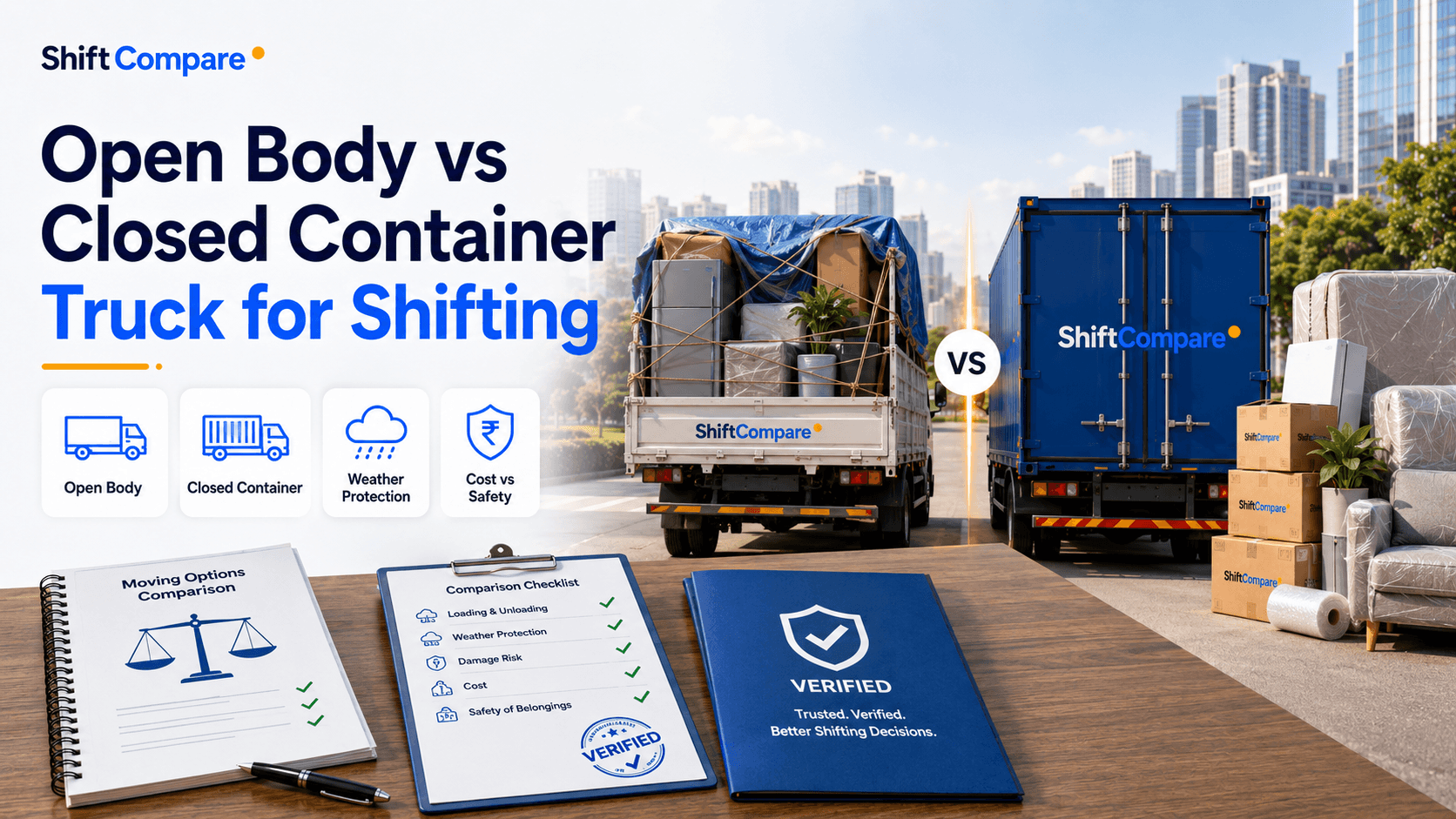
Quick comparison
The right answer depends on goods, distance and weather. For a short few-items local move, open body may be fine. For a proper house move, closed body is usually the calmer choice.
| Condition | Open body truck | Closed body truck |
|---|---|---|
| Few items, short local route | Can work | Better but not always needed |
| Mattress, sofa, electronics | Risky without strong covering | Safer |
| Monsoon or dust | Not ideal | Preferred |
| Intercity route | Avoid for household goods | Recommended |
Where open body truck makes sense
Open body truck can make sense for a very short local move, construction items, low-risk furniture, or a few cartons when loading and unloading are quick. It is also used when access is tight and a small open tempo is the only practical vehicle.
If you choose open body, ask about tarpaulin, tying, loading sequence and weather plan. A sheet thrown casually on top is not protection. It should be tied properly and goods should not be exposed during long waiting.
Where closed body truck is better
Closed body truck is better for household shifting because goods are protected from rain, dust, wind and casual handling. It also feels more controlled for mattresses, appliances, electronics, glassware and packed cartons.
For intercity moves, closed container should be treated as normal, not luxury. The truck may pass through multiple weather zones and highway halts. If your mover suggests open body for a long route, ask why.
Tarpaulin is useful, but limited
Tarpaulin helps during short movement, but it can leak, loosen or expose goods during loading and unloading. It also does not protect against dust in the same way as a closed body. If the goods are valuable, do not treat tarpaulin as equal to a container.
For July to September NCR moves, be extra careful. A short shower can spoil a mattress or particle-board furniture quickly. Closed body may cost more, but replacement cost is worse.
Local move examples
If you are moving two chairs, one table and a few cartons from one Gurgaon sector to another, open body with good covering may work. If you are moving a mattress, TV and fridge from Noida Sector 78 to Delhi, closed body is a better choice because the goods are more exposed during traffic and waiting.
For builder floors in Delhi, the vehicle may wait on the main road while goods are carried from the lane. Open body goods sitting outside during that waiting period can collect dust or get wet. For high-rise societies, the vehicle may wait near the service lift, so closed body reduces casual exposure.
Intercity move examples
For Gurgaon to Jaipur with a small 1 BHK, a closed body truck is still safer because the vehicle may stop on the highway and delivery may happen the next day. For Delhi to Mumbai, open body should not be used for household goods unless the load is industrial or low-risk.
Intercity goods face more vibration, weather changes and handling. If the mover offers a lower open-body price, ask what happens if rain enters, tarpaulin tears or goods are scratched. If that answer is unclear, the saving is carrying too much risk.
Cost difference and practical value
The closed-body price may be higher, but the value is in reduced exposure. That matters most for mattresses, fabric sofa, wooden furniture, books, electronics, glass and packed cartons. It matters less for plastic chairs, empty trunks and low-value loose items.
Ask the mover to write the vehicle body in the quote. "Tempo" is not enough. "14 ft closed body vehicle" or "Tata Ace open body with tarpaulin" gives you something real to compare.
Questions before accepting open body
Ask how the goods will be covered, who will tie the tarpaulin, what happens during rain, and whether fragile items will be packed separately. If the move has only metal trunks or plastic furniture, the answer may be enough. If it has electronics or mattresses, think twice.
Also ask whether the truck will stop anywhere before delivery. Open body is less worrying for a direct 20-minute local run. It is more worrying when the vehicle waits at a gate, pauses for another pickup, or crosses a long route in uncertain weather.
If you are using open body only to save a small amount, compare that saving with the value of the goods exposed during loading and waiting.
Questions before accepting closed body
Closed body is safer, but still ask for size and condition. A closed truck that is too small can damage goods through tight stacking. A dirty or leaking container can also create problems. Protection is useful only when the vehicle is suitable and loading is done properly.
If possible, ask the mover to send a vehicle photo before dispatch. It is a small check, but it prevents confusion between a covered pickup, a closed tempo and a proper container truck. These are not the same thing for household goods.
For expensive goods, also ask whether insurance is available and what proof the mover needs if a claim is raised later.
Insurance and damage proof
Vehicle body can affect damage risk, but claim proof still matters. Keep photos before loading, inventory list, quote, invoice and delivery remarks. If goods are wet, scratched or dented, write the issue before signing delivery as completed.
Read damage claim process and transit insurance charges before moving valuable goods.
What to write in the quote
Ask the mover to write vehicle size, open or closed body, packing scope, tarpaulin if applicable, labour count, GST, insurance and waiting rule. Unclear "tempo" or "truck" is not enough. Use the truck guide and truck calculator to check whether the quote fits your goods.