Packers Movers Inventory List: Avoid Missing Items
Tanuj
Founder, ShiftCompare Technologies Pvt. Ltd. · 2026-06-06

A missing-items fight is rarely lost on delivery day. It is lost earlier, when the crew loads your home without writing down what they took. I have seen careful families lose a clean claim on a cracked TV simply because nobody could prove the TV left the old house in one piece. The packers movers inventory list is the dull, single-page document that decides all of that, and most people sign it without reading it, if they get one at all.
Most people search for packers movers charges and company reviews. Fair. But after delivery, the pain is usually simpler: “Bhai, 2 cartons are missing, now what?” Use this list to check what packers movers should include, what they often skip, and how to protect yourself before signing delivery.
Why an inventory list is your real protection
Think of the inventory as the bridge between your home and any insurance you have paid for. Transit cover does not pay because you are upset. It pays against proof, and the inventory is the proof: this item, in this condition, at this value, was handed to the packers movers company. Without it, every dispute becomes your word against the crew’s, and the crew has done this a hundred times more than you have.
The same list does a second quieter job. It stops things going missing in the first place. A crew that knows every carton is numbered and signed for is a crew that loads and unloads more carefully, because a shortfall at delivery is on record. The list is both your evidence and your deterrent. For the wider checklist around it, our moving checklist covers the steps that sit alongside the inventory.
What packers movers should include in the inventory list
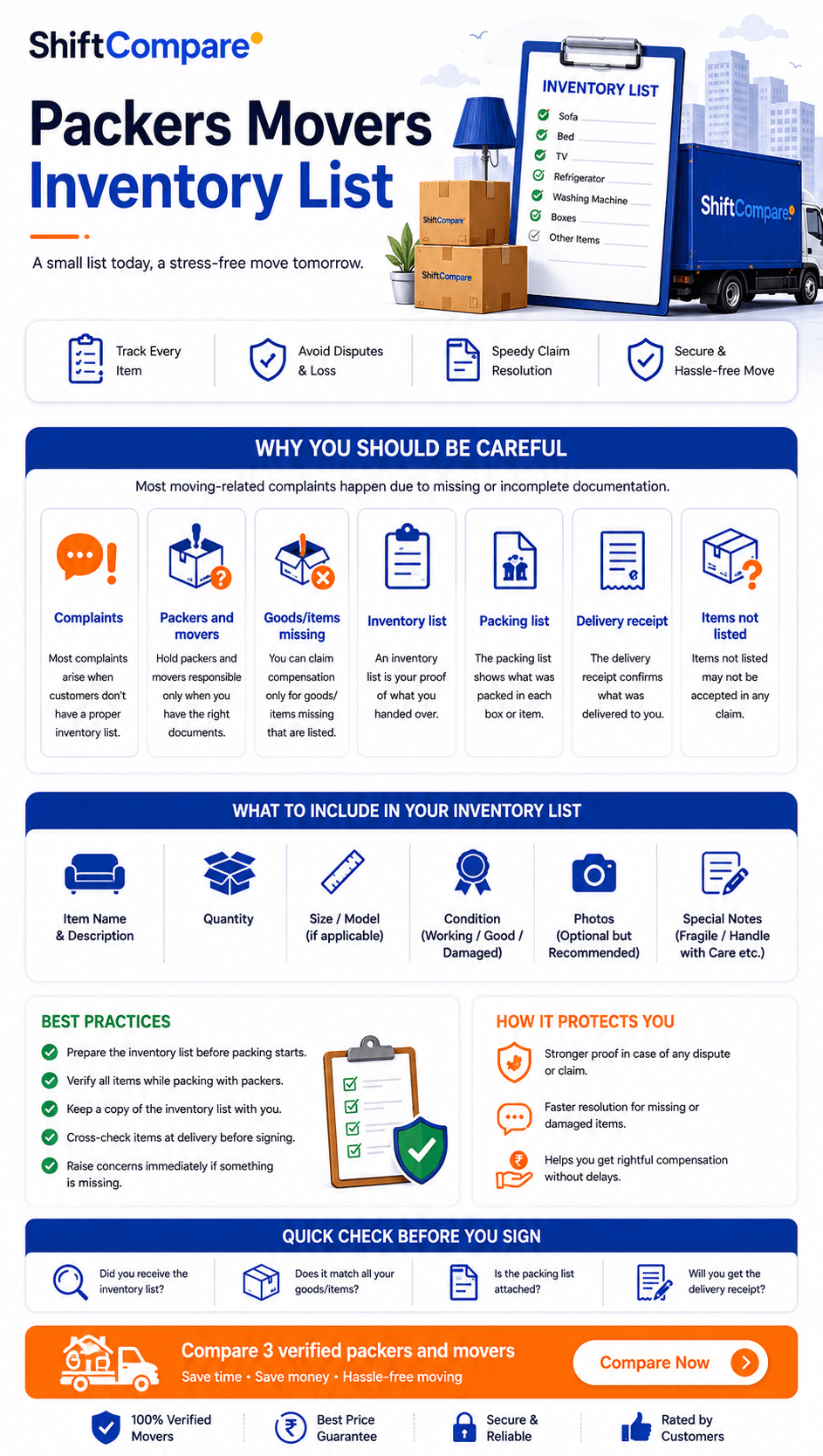
A good inventory is not a vague paragraph. It is a table, and each column earns its place. At minimum it should carry these fields.
| Column | What it records | Why it matters |
|---|---|---|
| Item name | Each article or carton, plainly named | So nothing is hidden inside a vague total |
| Quantity | The count of that item | So a shortfall at delivery is obvious |
| Condition code | State at pickup (new, used, scratched) | So existing wear is not blamed on the move |
| Box or carton number | A unique number on the box and the list | So you can tick off every box at delivery |
| Declared value | The worth of high-value items | So insurance has a figure to pay against |
Use 1 row per loose item or carton. A practical list has 6 fields: serial number, item name, quantity, condition code, box number, and declared value. If a packers movers supervisor gives you only a room-wise total like “kitchen items” or “bedroom goods”, ask them to break it into numbered rows before loading starts.
A list with item and quantity but no condition codes or box numbers is half a list. It tells you how many things there were, but not whether they arrived as they left, and not which carton is the one that did not turn up.
How condition codes work
Condition codes are short notes against each item describing its state when the crew packed it. A sofa might be marked used with a minor tear, a fridge marked a small dent on the left side, a dining table marked new. The point is simple: anything already worn is recorded, so it cannot later be passed off as move damage, and anything in good condition is on record, so genuine move damage is provable.
Read these codes before you sign. If the crew marks your six-month-old washing machine as scratched when it is spotless, that note will be used against you if it arrives damaged. Correct it on the spot. A crew that resists correcting an obviously wrong code is telling you something about how a claim will go.
Counting and numbering the boxes
Every carton should carry a number, and that number should appear on the list. This is the part people skip and regret. At delivery you do not want to be guessing whether all your boxes arrived. You want to stand at the door, read the numbers off the list, and tick each carton as it comes in. A missing number is a missing box, found in minutes, not discovered days later when you go looking for the kitchen things.
Number the high-risk cartons in your own mind too: the ones with electronics, documents, and small valuables. Those are the ones worth watching onto and off the truck yourself. If you are comparing how a packers movers company prices packing and handling, keep the Gurgaon charges page open so you can see what each line should cover.
Declared value and why it drives your insurance
Declared value is the figure that turns insurance from a comforting word into an actual payout. Transit insurance pays a percentage of declared value, so an item with no declared value, or a whole move covered by one vague lump figure, gives the insurer every reason to pay little or nothing. The television, the laptop, the refrigerator, the art on the wall: each high-value item should carry its own honest value on the list.
Do not inflate it, because a wildly high value invites scrutiny and can void a claim, and do not leave it blank to save time, because a blank is read as nothing to claim. Put the real replacement worth against the pieces you would genuinely claim for. Our guide to transit insurance for packers and movers explains how that value links to the premium and the payout.
Who prepares the list, and when
In most moves the packers movers supervisor builds the inventory during packing, room by room. That is normal, but it does not mean you hand it over and look away. Walk with the supervisor, confirm the counts as rooms are packed, and speak up the moment an item is missing from the list or a condition code looks wrong. The list becomes binding when you sign it, so the few minutes you spend checking are the few minutes that decide whether it protects you or the company.
If a crew refuses to make an inventory at all, treat that as a serious warning. A packers movers company confident in its handling has no reason to avoid writing down what it carries. A company that wants no record is planning for no accountability, which is exactly the pattern our moving scams guide warns about.
How to use the list at delivery
The inventory is only half-used at pickup. Its real moment is delivery. Keep your copy in hand, station yourself at the door, and check each item and carton number against the list as it comes off the truck. Do not sign the delivery as complete until you have accounted for every line. If a carton is missing or an item is damaged, note it on the delivery copy before you sign, because a clean signature tells the insurer you received everything in good order.
This is also where you avoid the most common trap: signing the delivery sheet in a hurry while boxes are still on the truck. Once you sign clear, you have closed the door on most claims. Take the extra twenty minutes. The crew may sigh, but the list is yours to clear, not theirs to rush.
Inventory for electronics and high-value items
Electronics deserve more than a line. For a television, a laptop, a camera, or an appliance, note the make, the model, and ideally the serial number on the inventory, alongside the condition and the declared value. A serial number ties the exact unit to the list, which makes a claim far harder to dispute and a swap or loss far easier to prove.
Photograph these items before packing too, screen on where possible, and keep the photos with your inventory copy. Between a serial number, a condition code, a declared value, and a dated photo, a damaged television becomes a provable claim rather than a frustrating argument. The questions to raise with the company about all of this are in our guide on questions to ask packers and movers before booking.
Common inventory mistakes that cost a claim
A handful of mistakes account for most failed claims. Signing the list without reading the condition codes. Letting expensive items go on with no declared value. Skipping carton numbers, so a missing box cannot be pinned down. Signing the delivery sheet clear while boxes are still being carried in. And accepting a move with no written inventory at all because the crew seemed nice and the day was rushed.
Each of these is avoidable in minutes. The inventory is not paperwork for its own sake. It is the difference, on the one bad day a move goes wrong, between a company that pays and a company that shrugs. Reading how to read a moving quote alongside this helps, because a quote that names your inventory and a list that matches it are two halves of the same protection.
Why the inventory matters more on a long-distance move
The further your goods travel, the more the inventory earns its keep. A move across the city is a few hours on the road with one crew you can watch. A long haul to another state can mean days in transit, a transhipment point where goods shift from one truck to another, and a delivery crew you have never met handing over what a different crew loaded. Every one of those handoffs is a place a carton can go astray, and the inventory is the thread that runs through all of them.
On a long route, insist that the same numbered list travels with the goods and is checked at each handover, not just at your two ends. When the delivery crew arrives, you are matching their truck against the list the loading crew signed, which is the only way to know whether everything that left actually arrived. This is why a written inventory is non-negotiable on intercity moves in particular, where the distance and the handoffs multiply the chances of a quiet loss. The same care that feels like overkill on a short local move is exactly what saves a long one.
A simple inventory format you can use
If the packers movers inventory list looks thin, ask them to use a fuller one, or keep your own alongside it. A workable format has one row per item or carton with these fields: a serial number, the item or carton name, the quantity, a condition code, the box number, and a declared value for anything worth claiming. Add a final row for the total carton count, and leave a column blank to tick at delivery.
Keep 2 signed copies, one with you and one with the company, and a photo set of the high-value items on your phone. That is the whole system. It is not complicated, and it does not cost anything, but it is the single most reliable thing you can do to keep a move honest. Whether you are moving across the city or on a long route like Delhi to Mumbai or Gurgaon to Noida, the inventory is what turns a promise into something you can actually hold the vendor to. For everything else around the move, start with packers and movers in Gurgaon and build the rest of your plan from there.
Tanuj
Founder, ShiftCompare Technologies Pvt. Ltd.
Tanuj runs ShiftCompare.in and CratoShift.in, having helped 500+ Delhi NCR families compare movers and avoid overcharging. He writes from actual field experience, not press releases.
LinkedInFrequently Asked Questions
What is a packers movers inventory list?
It is a written record of everything the packers movers company is carrying, with each item listed by name, quantity, condition at pickup, and a box or carton number. For high-value items it also notes a declared value. You sign it before loading and check items off at delivery, so anything missing or newly damaged is documented rather than disputed.
Why does the inventory list matter for an insurance claim?
Transit insurance pays against proof. If a carton is missing or an item arrives broken, the inventory list is what shows the item was handed over in good condition and at what declared value. With no list, the company can say the item was never loaded or was already damaged, and a claim usually collapses for lack of evidence.
Who prepares the inventory list, the customer or the packers movers supervisor?
The packers movers supervisor usually prepares it during packing, but you should check and correct it before signing. Walk each room with the supervisor, confirm the counts, flag any item that is missing from the list, and add a declared value for anything expensive. It is your signature that makes it binding, so read it first.
What are condition codes on a packers movers inventory?
Condition codes are short marks noting an item's state at pickup, such as scratched, dented, or used, so existing wear is not later blamed on the move. Good crews note them against fragile and high-value items. If a code looks wrong, correct it before signing, because the same list is used to judge any damage claim at delivery.
Do I need a declared value for every item on the list?
Not every item, but every high-value one. Electronics, appliances, art, and anything you would actually claim for should carry a declared value, because that figure sets what insurance pays if it is lost or broken. Everyday items can be grouped, but a vague total with no values for the expensive pieces leaves your cover meaningless.
What should I check before signing delivery?
Count every carton number against the inventory list, check visible damage on furniture and appliances, and write any missing box or new damage on the delivery copy before signing. A clean signature tells the company that everything arrived properly, so don't sign in a hurry.