How to Read a Moving Quote Line by Line
Tanuj
Founder, ShiftCompare Technologies Pvt. Ltd. · 2026-06-02
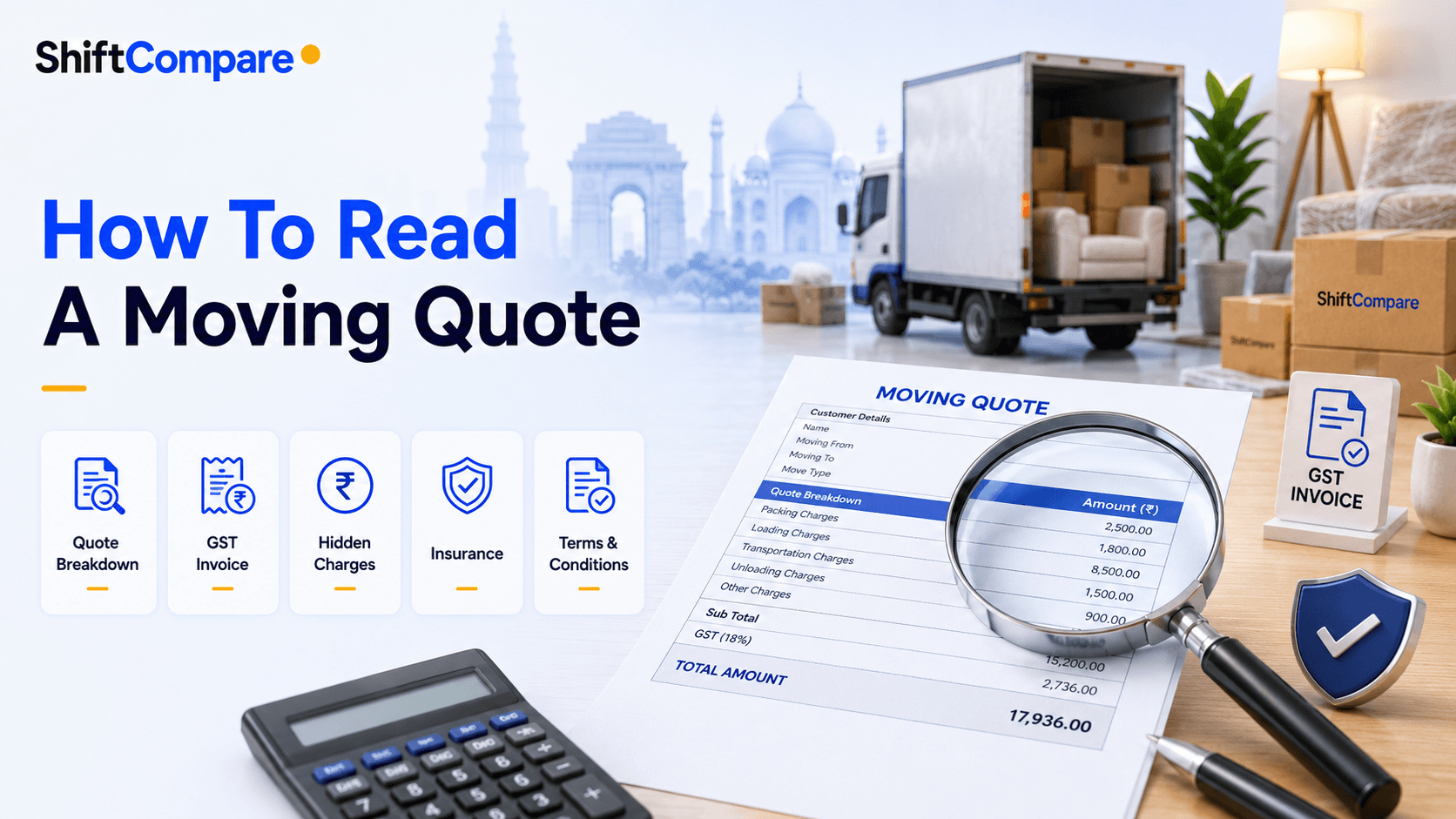
A moving quote is the most important document in your whole move, and the one people read the least carefully. Most of us glance at the total, compare it against another total, and book the lower one. In my years coordinating moves, that single habit, judging a quote by its bottom line, is behind more move-day disputes than anything else. A quote is not a price; it is a description of the work, and the total only means something once you understand the lines behind it.
So this is how to actually read a moving quote, line by line, and what each part should tell you. Learn to read one properly and you will spot a weak quote in a minute, compare two fairly, and never be surprised by a charge on move day.
Why the breakup matters more than the total
The first principle is simple: a number without a breakup is not a quote, it is a guess. When a mover gives you a single figure with no detail, you have no way to know whether it includes packing, whether GST is on top, whether a stair carry is priced, or what happens if the truck cannot reach your lane. That vagueness is not an accident; it is the room in which the price grows once your goods are loaded and you have no choice left.
A real quote breaks the price into clear lines and names your actual inventory, not just the BHK label. That breakup is what lets you check each part, compare two movers fairly, and hold the company to the number. Before you even collect quotes, set your own baseline with the moving cost calculator and the packers and movers charges guide, so you can tell a fair quote from a padded one. The breakup is the difference between booking with knowledge and booking on trust.
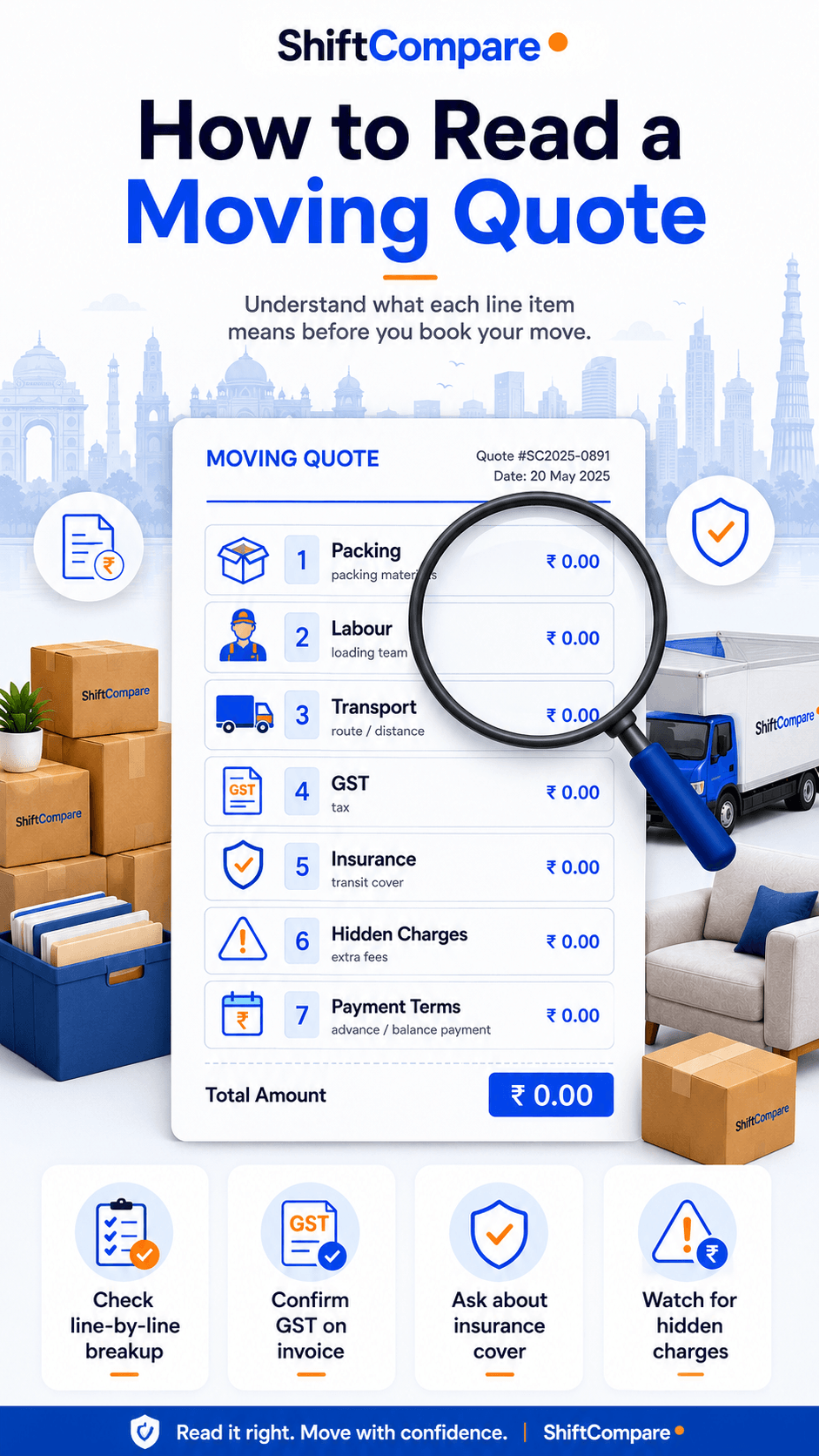
What should the packing material line show?
The first line to find is packing material. A good quote says what material is included, cartons, bubble wrap, foam, stretch film, wardrobe boxes and a crate or carton for the TV and glass, rather than just the word packing. The reason this matters is that packing quality is the single biggest factor in whether your goods arrive intact, and a thin packing line is where a cheap quote quietly cuts corners.
Look for specifics. Does fragile and high-value packing get crate-grade material or just a bubble layer? Are wardrobe and mattress covers included? The packing material charges guide explains what good material costs, and a quote that gives a suspiciously low packing figure is usually planning to under-pack or to add a packing upgrade later. When you read this line, you are really reading how carefully your goods will be treated.
The labour and handling line
Next is labour, which covers the crew that packs, loads, carries, unloads and places your goods. A clear quote states the crew count and, crucially, how it handles your access: stair carry if there is no lift, long carry if the truck parks far away, and dismantling and reassembly of furniture. These access realities are where local quotes quietly differ, because the same goods cost more to move up three floors than from a ground-floor flat with a lift.
Watch for the specialist work hiding inside labour. Furniture dismantling should be named per item, and a modular kitchen or fixed wardrobe needs a carpenter, as the furniture dismantling charges guide explains. An air conditioner is a technician job covered in the AC installation charges guide, not something the loaders do. If the labour line is just one figure with no crew count and no access detail, it is a line waiting to grow on move day.
What should the transport line tell you?
The transport line covers the truck or tempo, the route and the distance. On a local move this is straightforward, but check the vehicle size matches your inventory, because too small a truck means a second trip and a bigger bill. On an intercity move, this is the line that swings most, and the key question is the truck mode: a shared or part-load truck is cheaper but slower and handled more, while a dedicated truck costs more but is loaded once and delivered on your schedule.
A quote that does not say whether the truck is shared or dedicated is not comparable to one that does, because they are different products. The route guides like Delhi to Mumbai charges and Gurgaon to Noida charges show how transit time and truck mode shape this line. Read the transport line for the vehicle, the mode and, on a long haul, the transit days and the tracking, not just a number.
The GST and insurance lines
GST and insurance should each be their own clear line, and a quote that hides them is one to question. For GST, the quote should state whether it is 5 percent for transport-only or 18 percent for full packing-and-moving service, and confirm you get an invoice with the GSTIN. Verify that number on the Verify Packers Movers tool before you pay, because a clean GST invoice is your proof if anything goes wrong, and the GST charges guide explains how the tax sits on the bill.
Insurance is the line people most often find missing. A proper quote offers declared-value transit insurance, around 1.5 to 3 percent of the goods value, not just basic carrier liability that pays a token amount. The transit insurance charges guide covers how it works. When you read these two lines, you are checking whether the mover is set up to protect you, or whether they are leaving the tax and the risk for you to absorb later.
The hidden charges and add-on lines
The most dangerous part of a quote is what it does not say. Hidden charges live in the gaps: stair carry not mentioned, a narrow-lane shuttle not priced, waiting time with no free window, packing upgrades for fragile items, a society move-in fee, and a car or bike folded into the household total instead of quoted separately. The hidden charges guide lists the usual suspects, and the waiting charges guide explains the free window you should insist on.
So read a quote as much for what is absent as for what is present. If your home has a third-floor no-lift flat and the quote says nothing about stair carry, that is not a saving, it is a charge waiting to appear. The way to close these gaps is to ask, before booking, for each likely add-on to be named and priced, using the questions to ask before booking guide as your prompt. A quote with no surprises on move day is one where you forced every likely cost into the open beforehand.
The payment terms line
The last line to check is how you pay, and it is also your scam check. A safe quote stages the payment: a small token advance of around 10 to 25 percent, a share after loading, and a real balance held until after delivery and inspection. It also says the payment goes to a registered company account, not a personal one. The advance payment terms guide lays out the safe structure in detail.
The pattern to reject is any quote that demands full or near-full payment before the goods move, or a large cash advance to an individual. That held-back balance after delivery is your only real protection if something is damaged or missing, so a quote that removes it is removing your safety. Read the payment line as carefully as the price, because a fair total with unsafe payment terms is still a risky booking.
Putting it together: comparing quotes the right way
Once you can read a single quote, comparing several becomes easy and honest. Lay them side by side and check each line against the others, not total against total. Do both name the same inventory? Do both include packing, or did one leave it out? Is the truck mode the same? Are GST and insurance in both, or only one? When you line up the scope this way, the cheapest number is finally a genuine comparison, and very often the lowest total turns out to be the one missing the most.
This line-by-line habit is what turns a stack of confusing quotes into a clear decision. With the scope matched across movers, you can compare 3 verified movers on equal terms and pick on real value rather than on whichever total looked smallest. A moving quote read carelessly is a trap; read line by line, it is the best tool you have for a move with no surprises. Spend ten minutes decoding it before you book, and you save yourself the far longer argument that an unread quote invites on move day.
A worked example of reading two quotes
Imagine two quotes for the same 2 BHK move. Quote A reads Rs 18,000 as a single figure with the word packing and nothing else. Quote B reads Rs 22,000 but breaks down as packing material Rs 5,000, labour with a four-person crew and stair carry Rs 6,000, a dedicated truck Rs 8,000, GST at 18 percent, and declared-value insurance offered separately. On the totals alone, Quote A looks like the winner by four thousand rupees, and that is exactly how people get caught.
Read line by line, the picture flips. Quote A does not say whether GST is included, does not mention the stair carry your second-floor flat needs, and does not name the truck mode, so its real cost will almost certainly climb past Quote B once those appear on move day. Quote B, higher on paper, is the honest one, because every cost is already on the table and there is nothing left to surprise you. Nine times out of ten, the quote that looks slightly more expensive but spells everything out is cheaper by the end of the move. That single insight, that a transparent quote beats a cheap-looking vague one, is the whole reason to read line by line.
Red flags to reject a quote outright
Some quote patterns are not worth negotiating; they are reasons to walk away. A flat lump sum with no breakup, even after you ask for one, tells you the mover does not want you to see the parts. A demand for full or near-full payment before loading is the clearest scam signal, as the moving scams guide explains. A refusal to give a GST invoice, or a GST number that does not verify, means you have no proof and no recourse if something goes wrong.
Other red flags are softer but still telling: a quote that never asks your floor, your lane or your inventory, because it cannot be accurate without them; a packing figure so low it implies under-packing; or insurance that is brushed aside as not needed. When you see these, the right move is not to haggle but to set that quote aside and read the next one. A move is too important to hand to a company that will not put its own pricing in writing, and the quotes that pass this reading are the only ones worth comparing.
Tanuj
Founder, ShiftCompare Technologies Pvt. Ltd.
Tanuj runs ShiftCompare.in and CratoShift.in, having helped 500+ Delhi NCR families compare movers and avoid overcharging. He writes from actual field experience, not press releases.
LinkedInFrequently Asked Questions
What should a proper moving quote include?
A proper quote should name your inventory and break the price into packing material, labour, transport or truck, GST, insurance and any access add-ons like stair carry or a shuttle. It should also state the payment schedule and the delivery timeline. Each line should be specific, not bundled into a single figure.
Why is a single lump-sum quote a problem?
A lump-sum figure hides what is included and what is not, which is exactly the gap that lets the price grow on move day. Without a line-by-line breakup you cannot tell whether packing, GST, stair carry or insurance are in the number, so you cannot compare two quotes fairly or hold the mover to the price.
How do I compare two moving quotes that look different?
Put them side by side line by line, not total against total. Check that both name the same inventory, the same truck mode, and include or exclude the same things. A lower total often only looks cheaper because it left out packing, GST or a shuttle that the other quote included.
Where do hidden charges hide in a quote?
Hidden charges hide in the lines a quote leaves vague: stair carry, long carry, a narrow-lane shuttle, waiting time, GST added later, packing upgrades for fragile items, and a vehicle folded into the household total. Ask for each to be named and priced before you book.
Should GST and insurance be inside the quoted price or separate?
They should be shown as separate, clearly stated lines so you know exactly what you are paying. GST is usually 5 percent for transport-only or 18 percent for full service, and insurance is a percentage of declared value. A quote that hides whether they are included is one to question.