Advance payment terms: quick split list
Here is the fast list of how a fair payment splits across the move, with an example on a Rs 30,000 quote so the rates are concrete. Read the stages, then check the red flags and the on-quote section below, because the payment mode and the delivery-linked balance are what actually protect your money.
| Payment stage | Typical share | On a Rs 30,000 quote |
|---|---|---|
| Booking advance | 10 to 25 percent | Rs 3,000 to Rs 7,500 |
| After loading | 40 to 60 percent | Rs 12,000 to Rs 18,000 |
| After delivery and check | Remaining balance | Rs 6,000 to Rs 12,000 |
| Local small move | Two-part split | Advance plus the rest on delivery |
| Intercity move | Three-part split | Advance, post-loading and post-delivery |
What a fair advance actually is
An advance is a token to hold your date and reserve the crew and truck, not a payment for the whole job before it starts. A genuine mover asks for a small share at booking and earns the rest as the work happens: more after loading, the balance after delivery. The structure exists to keep both sides honest, and the moment it tilts toward most of the money upfront, your protection is gone. For the wider bill, see the main charges guide and the hidden charges page.
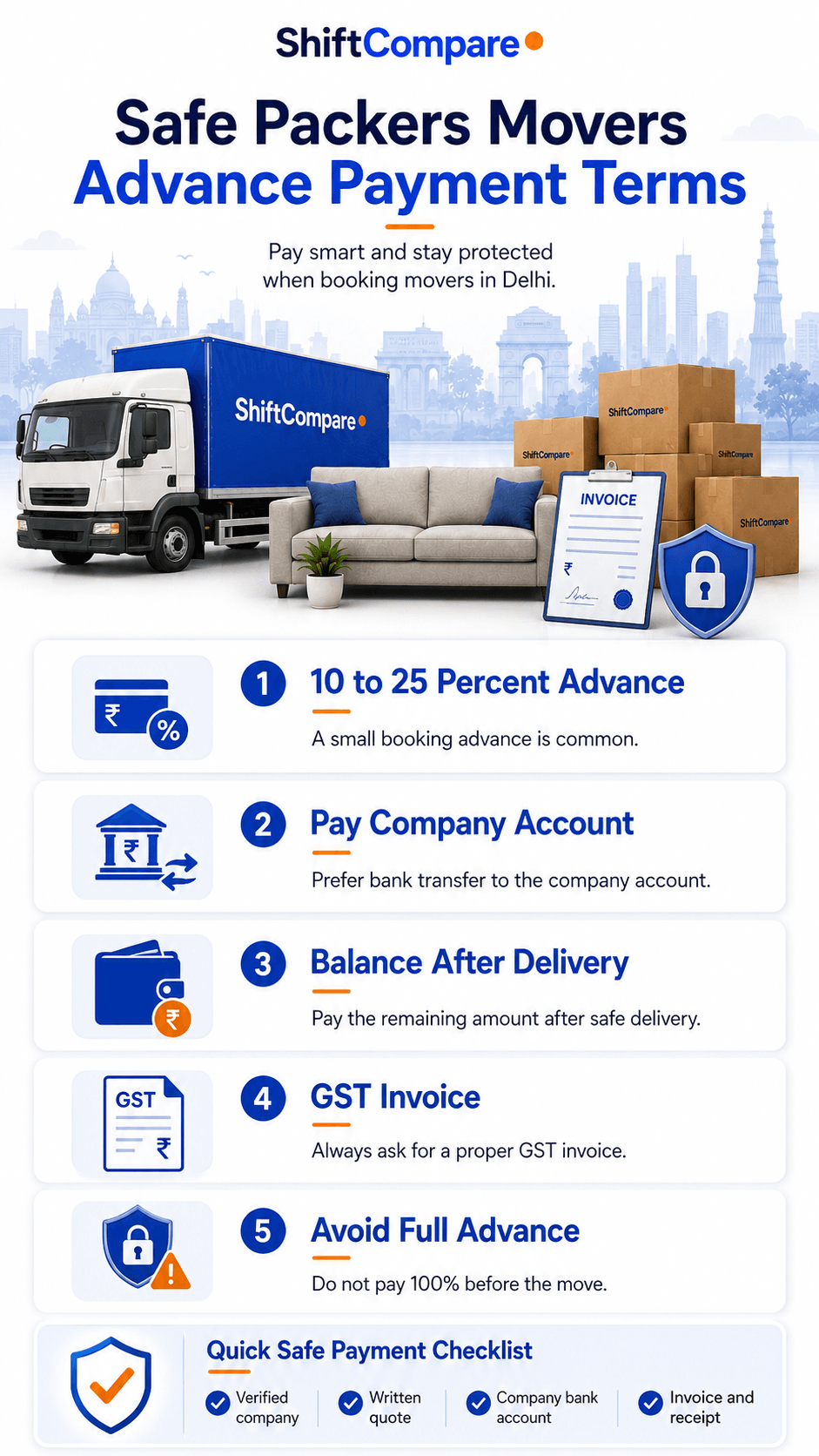
A fair advance is a small token to hold the date, not most of the bill, so 10 to 25 percent is the normal range.
Keep a real balance tied to delivery, because that held-back amount is your only bargaining power if something is damaged or missing.
Pay to a registered company account against a GST invoice, never a large cash sum to an individual.
A demand for full or near-full payment before the goods move is the single clearest sign of a moving scam.
Quick payment split
Use this split as a guide. A final quote should write each stage and amount, paid to a company account on a GST invoice.
Use Full CalculatorToken advance at booking
10 to 25%
Small amount to hold the date and crew.
Payment after loading
40 to 60%
Paid once goods are packed and on the truck.
Balance after delivery
Remainder
Paid after inspection at the new home.
How advance payment terms are calculated stage by stage
This is the structure that keeps your money working for you through the move. Match the split to your move type and make sure each stage is written.
| Stage | Share | Note |
|---|---|---|
| Booking advance | 10 to 25 percent | A token to hold the slot, paid to a verified company account |
| After loading | 40 to 60 percent | Paid once goods are packed and loaded, not before |
| After delivery and check | Remaining balance | Paid after inspection at the new home, before sign-off |
| Local small move | Often advance plus on-delivery | A two-part split is common for short same-day moves |
| Intercity move | Three-part split | Advance, post-loading and post-delivery suits a long haul |
Payment red flags that signal a scam
These are the payment patterns we tell people to walk away from. Any one of them is a reason to pause and read the moving scams guide before transferring a rupee.
| Red flag | Why it is dangerous |
|---|---|
| Full payment before loading | The clearest scam signal. No genuine mover needs the whole amount before the goods move. |
| Large cash-only advance | A big advance demanded in cash with no GST invoice leaves you no proof and no recourse. |
| Payment to a personal account | A transfer to an individual, not a registered company account, is hard to trace if things go wrong. |
| Advance before any survey | A big advance pushed before a survey or written quote, often with a truck-waiting story, is pressure, not service. |
| No delivery-linked balance | If nothing is held back until after delivery, you lose your only bargaining power if goods are damaged or missing. |
How to read payment terms on a real quote
This check is the difference between a safe booking and a costly one. A unclear payment line is the gap a scam needs, so compare each mover against these points before you transfer anything.
| Term | Risky quote | Safe quote |
|---|---|---|
| Advance size | Most or all upfront | A token 10 to 25 percent at booking |
| Balance link | Full payment before delivery | A clear balance held until after delivery check |
| Payment mode | Cash to a personal account | Company account with a GST invoice |
| Written schedule | Decided verbally | Each stage and amount written before booking |
With the payment schedule written, you can compare 3 verified movers on the same terms instead of trusting a verbal promise.
GST, proof and your protection
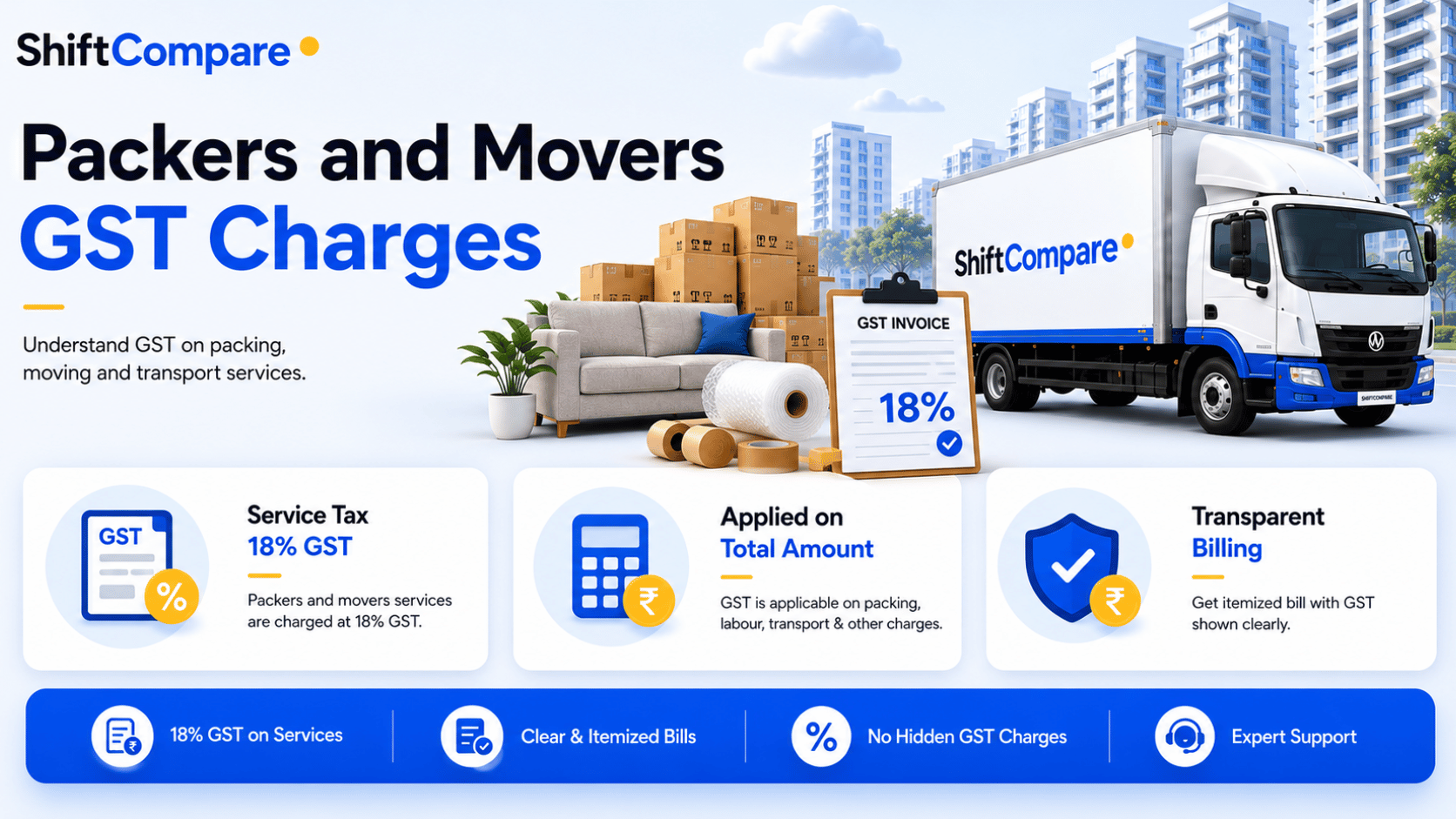
GST applies to the full moving service, usually 18 percent for packing and moving, and your advance is part of that taxed amount. Ask for a GST invoice that shows the advance and the balance separately, and verify the GSTIN on the Verify Packers Movers tool before you transfer anything. A mover who cannot give a GST invoice for an advance is one to avoid.
Your protection comes from three habits together: pay to a registered company account so the transfer is traceable, keep the balance tied to delivery and inspection so you have bargaining power if goods are damaged, and pair the payment with declared-value cover from the transit insurance charges guide. A token advance, a delivery-linked balance and a GST invoice are what turn a moving payment from a risk into a record.
How to stage the payment in practice
The cleanest way to run a moving payment is to treat each stage as a gate that opens only when the work behind it is done. At booking, pay the token advance to a company account and get the GST invoice that names the advance and the balance. Do not let a verbal promise stand in for that invoice, because the invoice is what makes every later stage enforceable. On move day, release the post-loading share only after the goods are actually packed and on the truck, not when the crew arrives, since paying before loading hands over your bargaining power for nothing.
At the new home, hold the final balance until you have walked the rooms and checked the fragile items and the appliances. This is the moment the delivery-linked balance earns its place: if a TV is cracked or a carton is missing, the unpaid balance is what gets it resolved quickly rather than through weeks of calls. Pay the balance once you are satisfied, take a final receipt, and keep the whole thread, the quote, the invoice and the payment proofs, in one place.
For an intercity move the same logic stretches across more days, so the three-part split matters even more: the truck is out of your sight for the transit, and the held balance is your assurance that it arrives and is handed over properly. Whatever the move length, the rule does not change. A small token to start, payment that tracks the work, and a real balance tied to a clean delivery is the structure that keeps your money safe and the mover motivated to finish the job well.
Advance payment terms FAQ
What are normal packers and movers advance payment terms?
A fair advance is usually 10 to 25 percent of the quote to hold the date and crew, with the balance split between after loading and after delivery. A demand for full or near-full payment before the goods move is the clearest sign of a scam, so insist on a small token advance and a delivery-linked balance.
How much advance should I pay packers and movers?
Pay a token advance of about 10 to 25 percent at booking, no more. The rest should follow in stages: a larger share after loading and the balance after you inspect the goods at the new home. Paying most of the bill upfront removes your protection.
Is it safe to pay full advance to packers and movers?
No. Full payment before the goods move is the clearest moving-scam signal, because once the mover has the whole amount there is no incentive to deliver carefully or on time. Always keep a real balance tied to delivery and inspection.
How should I pay the moving advance?
Pay to a registered company bank account against a GST invoice, not a large cash sum to a personal account. A traceable payment with a proper invoice is your record if there is a dispute, damage or a missing-goods claim later.
What is a safe payment schedule for an intercity move?
A three-part split works best on a long haul: a token advance at booking, a larger share after loading, and the balance after delivery and inspection. This keeps your bargaining power through the days the goods are in transit.
Is GST charged on the advance?
GST applies to the full service, usually 18 percent for packing and moving, and the advance is part of that taxed amount. Ask for a GST invoice that shows the advance and the balance, and verify the GSTIN before you transfer anything.
What if a mover insists on a big advance before a survey?
Treat it as a warning. A genuine mover surveys or at least takes a written inventory before asking for a token advance. A large advance demanded before any survey, often with a truck-waiting story, is pressure that real movers do not need.
Helpful next reads
Guides worth opening next
Still checking a quote? Pick the guide that matches the line you are unsure about, then compare the same packing, GST, labour and delivery terms.