The HR Guide to Modern Employee Relocation Policies
Tanuj
Founder, ShiftCompare Technologies Pvt. Ltd. · 2026-03-28
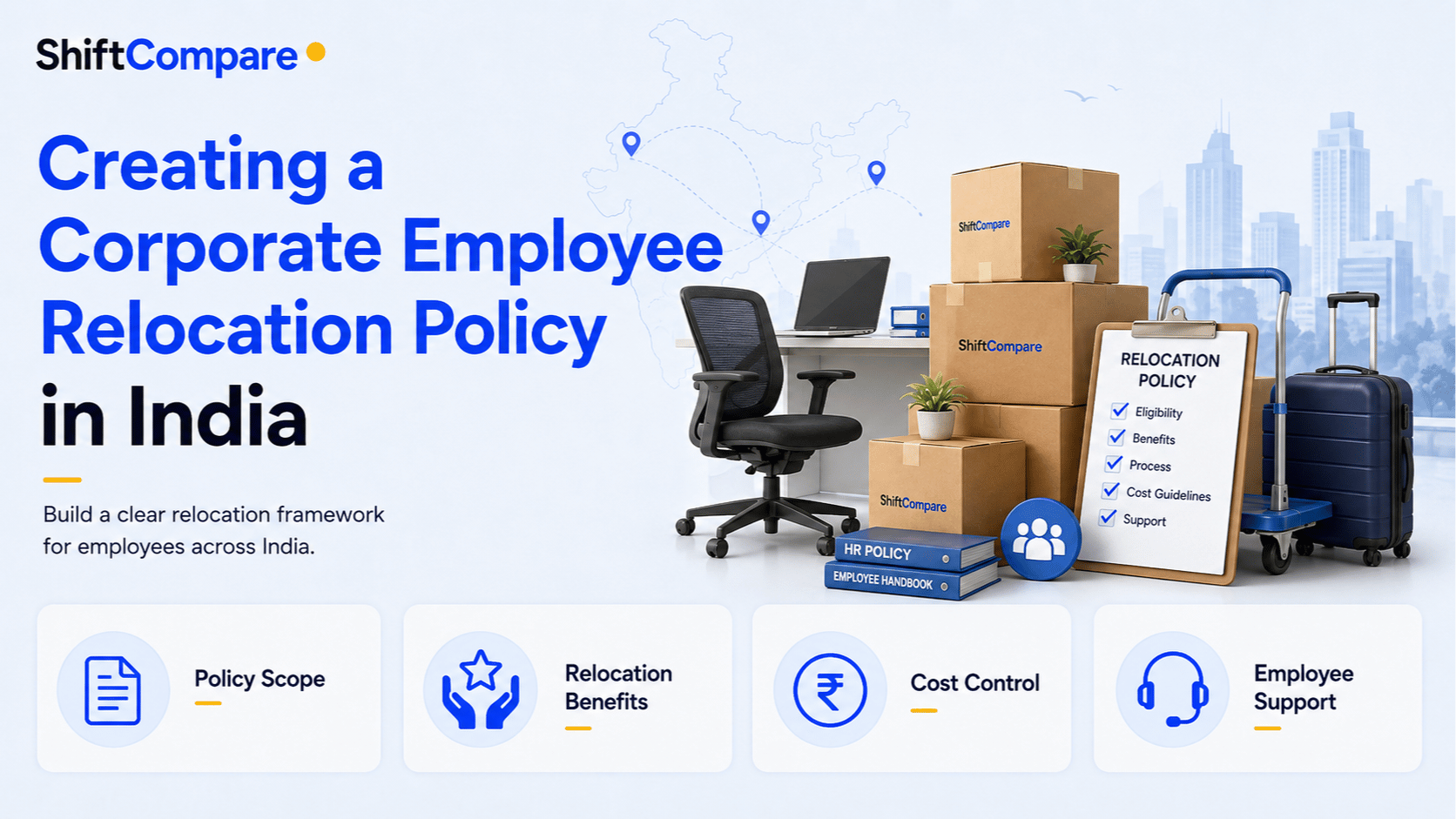
A good employee relocation policy in India should tell the employee what is paid, who books the vendor, how GST invoices are handled, and what happens if goods are damaged. HR should not leave the employee alone with a random mover. A written policy protects the employee, the finance team, and the company budget.
A structured corporate relocation policy is no longer a luxury perk. It is a fundamental requirement for talent retention.
How much should companies budget for employee relocation?
Corporate relocation budgets in India vary drastically by seniority. A blanket “₹20,000 for everyone” policy simply does not work.
Junior employees / fresh graduates: Generally moving from PG accommodation with minimal furniture. Typical lump-sum allowance: ₹15,000 to ₹25,000. Covers flight ticket, basic luggage transport, and security deposit for a new rental.
Mid-level managers (with spouse/children): Moving a fully furnished 2 BHK. Companies often pay the logistics vendor directly rather than giving a lump sum. Typical budget: ₹30,000 to ₹50,000.
Senior executives and directors: Low-friction, full-service moves. Budget: ₹75,000 to ₹1,50,000. Professional packers box every single item, transport vehicles, and unpack at the destination. A completely hands-off experience.
What should an Indian relocation policy cover?
A well-written policy details exactly what expenses qualify for reimbursement.
Primary coverage: Physical transport and packing of household goods - corrugated boxes, bubble wrap, loading labor, and truck freight.
Transit insurance: The company must cover the 1-3% premium for declared-value coverage. If the truck meets with an accident and destroys the employee’s furniture, the HR department faces a difficult claim situation if goods were uninsured. Read our transit insurance guide for a full breakdown of coverage types.
Temporary housing: Finding a good apartment takes time. Companies typically provide 7 to 14 days of paid accommodation in a corporate guest house or business hotel. High-end policies also offer school transfer assistance for executives with children.
| Policy item | Usually included | HR approval note |
|---|---|---|
| Household goods move | Packing, loading, transport and unloading | Needs written inventory and GST invoice |
| Vehicle transport | One bike or one car for eligible employees | Ask for RC, insurance and handover photos |
| Temporary stay | 7 to 14 days for approved bands | Set nightly cap before travel |
| Society charges | Often reimbursed in NCR moves | Require receipt from RWA or facility office |
How can HR protect employees from mover fraud?
The logistics industry still has a large unorganized segment. If you hand an employee ₹40,000 and tell them to find their own truck, they might fall victim to moving scams. Fraud vendors trap goods mid-transit and demand extortion money for delivery.
Mandate that employees only hire companies that provide legitimate GST invoices. Teach your HR team to verify vendors using our GST tool. Also require a pre-move physical survey - no quotes generated over the phone. The vendor must assess the volume of goods in person, ensuring the final invoice matches the estimate without surprise surcharges.
For full coverage of scam tactics targeting individual movers, read our moving scams guide. Corporate HR teams need to be aware of these tactics too.
What vendor checks should HR complete before approval?
Before approving any vendor invoice, HR teams should confirm:
- GST registration number verified on gst.gov.in
- Full transit insurance certificate from HDFC Ergo, ICICI Lombard, or similar recognized insurer
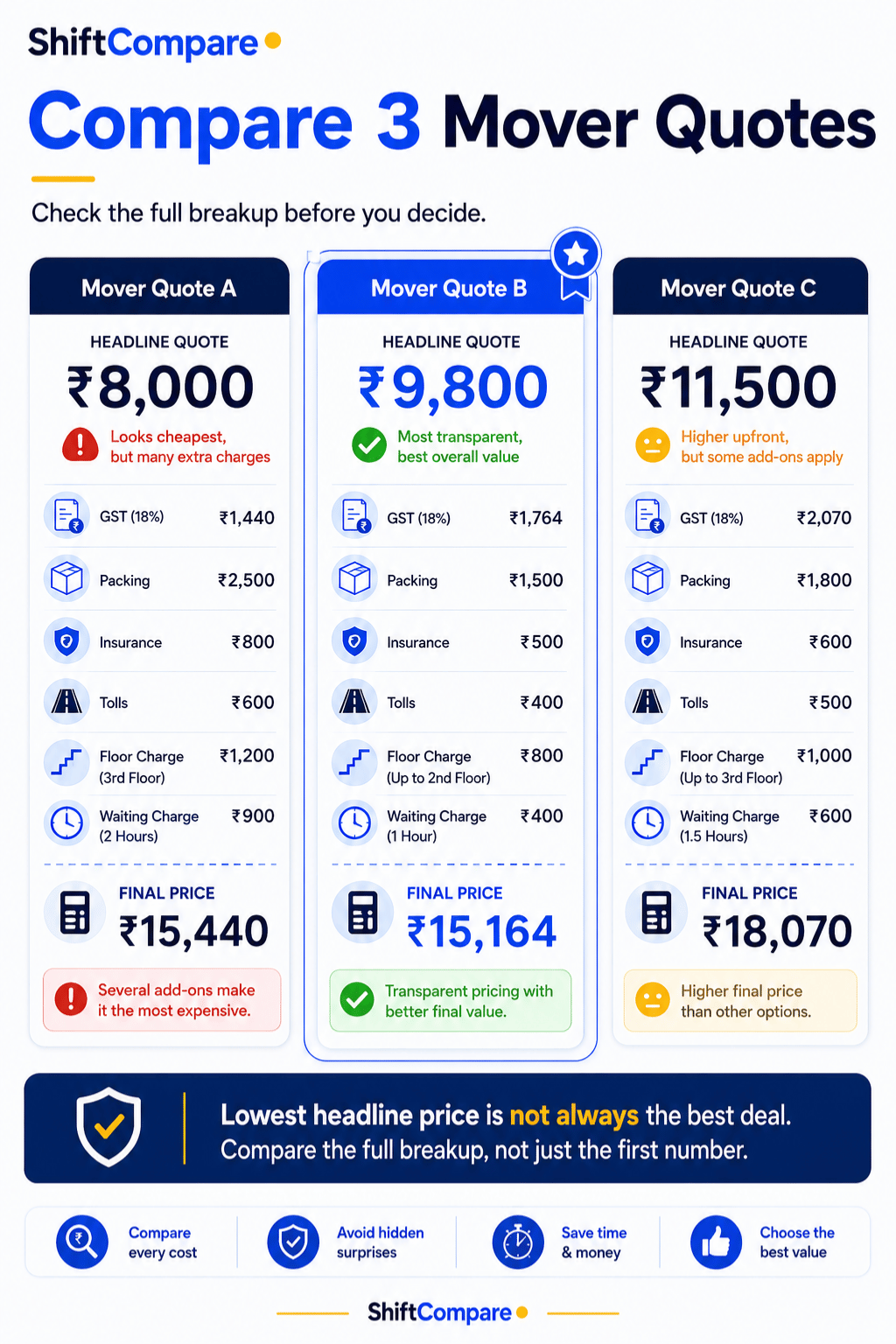
- Quote clearly separates packing costs, freight charges, and applicable GST
- Employee has signed a pre-move inventory list
- Vendor approved by or listed on a verified platform
Red flags for HR: no GSTIN, no physical survey, no inventory list, very low advance demand followed by vague delivery terms, and insurance promised verbally without a policy copy. These are the cases where employee support tickets usually start after goods are already packed.
Which official sources should HR keep in the policy?
Add the GST taxpayer search guide to the vendor approval checklist. For employee claims and disputes, link the National Consumer Helpline. For car relocation, ask employees to keep RC and insurance copies ready and use Parivahan for vehicle-related services.
What should HR know about Delhi NCR relocations?
When employees relocate into premium Gurgaon areas like Sector 67 or DLF Phase 3, there are additional costs that need to go into the policy budget:
- RWA move-in deposits: ₹5,000 to ₹25,000 (refundable, but paid upfront)
- Elevator booking fees: ₹1,000 to ₹3,000
- Society administrative charges: ₹2,000 to ₹5,000
These costs are paid directly to the society and are entirely separate from the mover’s invoice. A well-written policy should either reimburse these explicitly or increase the Delhi NCR base budget by ₹10,000 to ₹20,000 to account for them.
For office-level relocations involving an entire division, the logistics scale up significantly. Connect with established Gurgaon corporate movers who understand B2B invoicing and GST documentation. You can also explore verified Delhi services for cross-city transfers. Use our moving calculator to help employees estimate their actual entitlements before they start negotiating with vendors.
Policy writing is different from mover booking
An HR relocation policy should not read like a mover quote. It should define what the company pays for, what proof is required, and where approvals happen. The actual vendor quote can change by city, BHK, route, and access. The policy should stay steady.
For price checks, HR teams can use intercity packers movers charges and city pages like packers movers Gurgaon or packers movers Delhi. The policy itself should answer reimbursement rules.
| Policy item | Why it matters | Practical wording |
|---|---|---|
| Eligibility | Stops confusion | Role, grade, transfer type, joining date |
| Move limit | Controls budget | BHK or capped amount by city pair |
| GST invoice | Supports finance | Invoice must carry vendor GSTIN |
| Insurance | Protects employee goods | Declared value and policy proof required |
| Storage | Handles delayed housing | Days covered and approval rule |
| Claims | Avoids argument | Photos, invoice, and damage report required |
Set city-pair caps without making them fake
Do not set one India-wide amount for every move. A Gurgaon to Noida local move, Delhi to Bangalore transfer, and Gurgaon to Pune relocation have different cost behaviour. If the cap is too low, employees will either choose unsafe movers or ask for exceptions every time.
Set bands by move size and route type. Local NCR, regional intercity, and long-haul metro moves should not sit in one bucket. Review the cap once or twice a year, not after every complaint.
GST and finance proof
Finance teams need clean documents. The policy should say that reimbursement requires a GST invoice where applicable, payment proof, and a quote or bill showing service breakup. If the employee pays cash to an unknown mover and submits a rough bill, finance will struggle.
For GST treatment, share packers movers GST charges with HR and finance. For identity checks, the employee can use Verify Packers Movers tool. Keep both steps in the policy.
Insurance and damage claims
Corporate relocations go bad when damage responsibility is unclear. The employee thinks the company chose the mover. The company thinks the employee booked the mover. The mover says the claim was not documented. The policy must decide this before the move.
Require pre-move photos for high-value items, declared value, and insurance proof for intercity moves. For expensive electronics, cars, bikes, artwork, or storage, ask for separate listing. The claim process should mention reporting window, photos, delivery sheet notes, and vendor contact.
What I would put in a simple approval flow
One approval before booking. One document check before payment. One delivery confirmation after the move. That is enough for most companies. Too many approvals slow the employee down. Too few approvals create finance disputes.
For Gurgaon office-heavy teams, also include access realities. Employees moving from Cyber City service apartments or Sohna Road societies may face lift timing, parking, and long carry. The policy should allow reasonable access charges when written in the quote.
My HR rule
A relocation policy should protect the employee without becoming a blank cheque. Cover real moving needs, require clean proof, and keep exception approval human. People are already stressed during transfers. Good policy removes arguments before they start.
Reimbursement rules that prevent awkward HR calls
Add a small exception rule. Employees should know who can approve extra charges when society rules, storage delays, or route restrictions change the bill. Without that rule, HR gets urgent calls on moving day and finance gets a messy invoice later.
I also like a pre-approved vendor panel, but do not make it too rigid. Sometimes a route needs a specialist. Sometimes a city branch is stronger than the national vendor. The policy should allow a second quote when the first vendor cannot explain GST, insurance, or delivery timing properly.
For senior transfers, include one line on temporary accommodation and storage. A family moving before the new lease is ready may need five to ten storage days. If storage is not mentioned, everyone starts negotiating after the goods are already packed. That is the worst time to decide policy.
A good policy feels boring. That is the compliment. It tells employees what is covered, tells HR what to approve, and tells finance what proof to expect.
What finance should audit once a quarter
Once a quarter, finance should review five relocation files. Check whether the approved cap matched the route, whether GST invoices were collected, whether insurance was used correctly, and whether employees had to pay surprise charges. This is not about blaming anyone. It is how policy becomes real.
If the same exception repeats, add it to the policy. If storage gets approved again and again, define storage. If employees keep submitting non-GST bills, add a pre-booking document check. If long route moves keep crossing the cap, update the route band instead of forcing every employee into an exception.
HR should also collect employee feedback after delivery. One simple question works: would you use this mover again for your own goods? That answer tells you more than a polished vendor deck.
A relocation policy should improve quietly every quarter. Small edits prevent big reimbursement fights.
Vendor scorecard I would keep
Track four things after every employee move: final bill versus approved quote, delivery delay, damage complaint, and document quality. A vendor who is cheap but submits poor GST invoices will irritate finance. A vendor who is polite but delays delivery will irritate employees. The scorecard should reward clean paperwork and calm delivery, not only low price.
After five to ten moves, patterns become clear. Keep the vendors who explain problems early. Remove the ones who make HR chase basic documents.
Tanuj
Founder, ShiftCompare Technologies Pvt. Ltd.
Tanuj runs ShiftCompare.in and CratoShift.in, having helped 500+ Delhi NCR families compare movers and avoid overcharging. He writes from actual field experience, not press releases.
LinkedInFrequently Asked Questions
Should the company pay the moving vendor directly or give the employee an allowance?
For mid-level and senior employees, it is much safer for the company to pay the vendor directly against a verified GST invoice. This ensures the funds are used for professional logistics and allows the company to claim GST input tax credit, saving the business money.
Do corporate policies cover the transport of personal cars?
Yes, standard mid-level and senior relocation policies cover transport of one personal vehicle in an enclosed car carrier. However, the company only pays for transport - the employee handles state road tax and re-registration paperwork themselves.