The 8-Week Moving Checklist and Timeline
Tanuj
Founder, ShiftCompare Technologies Pvt. Ltd. · 2026-06-02

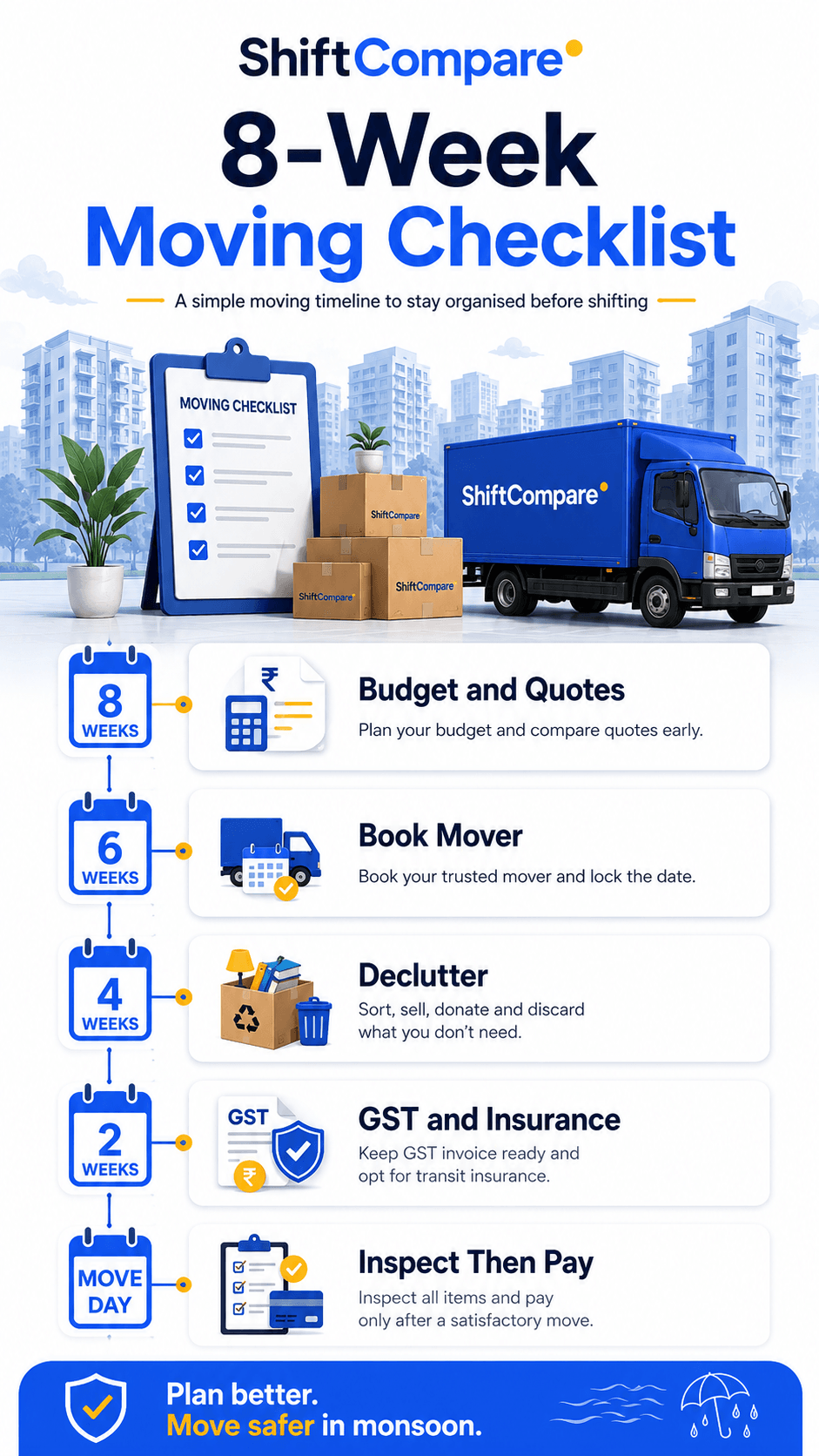
The difference between a calm move and a chaotic one is almost never the mover; it is how early you started. In my experience, the families who plan a move across weeks, rather than cramming it into the last frantic few days, end up paying less, choosing better movers and arriving without the usual exhaustion. A move has a natural rhythm, and when you work with it instead of against it, even a big intercity shift feels manageable.
This is a week-by-week timeline you can follow, built around an 8-week runway for an intercity move. If you are moving locally, you can compress it into 3 or 4 weeks, but the order of tasks stays the same. Read it once now, then come back to each stage as it arrives.
What should you do 8 weeks before moving?
The first job is to turn a vague intention into a plan with a number. Work out a rough budget by sizing your home and running it through the moving cost calculator, and read the packers and movers charges guide so you know what the bands look like for your move. This early baseline is what stops a mover from inflating the price later, because you walk into every conversation already knowing the ballpark.
This is also the week to start gathering quotes. Reach out to a few movers, describe your home and both addresses honestly, and ask each for a written, itemised quote rather than a phone figure. The questions to ask before booking guide gives you the exact list to run through. Starting 8 weeks out means you are comparing calmly, not booking the first available truck under deadline pressure, and that calm is worth real money.
Six weeks out: compare and book a verified mover
By now you should have two or three written quotes to compare. Do not judge them on the headline total alone; line up the scope behind each, the packing, the GST, the insurance, the crew and the access handling, so the cheapest number is a genuine comparison and not a quote missing half the work. Verify each mover’s GST number on the Verify Packers Movers tool and look for reviews that mention real, specific details.
Once you have chosen, book and lock your date. Around six weeks out is the sweet spot for an intercity move, because it secures a verified crew before month-end and peak-season demand tightens. For a local move, two to three weeks is usually enough. When the scope is clear and consistent across movers, you can compare 3 verified movers and commit with confidence. Get the payment schedule, the GST invoice terms and the truck mode written into the booking, so nothing is left to a verbal promise.
Four weeks out: declutter and sort documents
The single best way to cut your moving cost is to move less, and four weeks out is the time to do it. Go room by room and sell, donate or discard what you no longer use, because every carton and every kilo you do not move is money saved on truck size and labour. Old furniture, unused appliances and years of accumulated clutter are exactly the dead weight that inflates a quote, so be ruthless now while there is time.
This is also the week to handle paperwork. Start the address-change process for your bank, your workplace, subscriptions and any official records, and gather important documents into one folder you will carry yourself, never in the truck. If you are moving intercity, this is when to confirm the transit details on your route, the Delhi to Mumbai charges page and similar route guides show how transit days and truck mode work, so you can plan your own travel and arrival around the goods.
Two weeks out: confirm logistics, GST and insurance
Two weeks out is when the plan becomes concrete. Reconfirm the mover’s date and timing, and lock the practical access details at both ends: the society service-lift slot, the gate pass, and the parking, because a missed lift slot is the most common cause of a waiting charge on move day. Tell the mover about any narrow lane, no-lift floor or stair carry so it is priced now rather than improvised later.
This is also the moment to nail down GST and insurance. Confirm the GST rate and that you will get a proper invoice, and decide on declared-value transit insurance using the transit insurance charges guide, photographing your major and fragile items before they are packed. If you have special items, a modular kitchen needing furniture dismantling or an air conditioner needing AC uninstall and reinstall, confirm those are scheduled with the right technicians. Two weeks out, the goal is that nothing about move day is still undecided.
One week out: pack, prepare and reconfirm
The final week is for finishing the packing and keeping the last days light. Pack everything non-essential, label cartons by room, and keep aside only what you will use in the last few days. Pack a first-night bag for each family member, bedding, toiletries, a change of clothes, chargers, medicines, so that when you arrive tired you are not opening ten cartons to find a toothbrush. Set your documents, jewellery and laptop aside to carry yourself.
Reconfirm everything with the mover a day or two before: the reporting time, the crew and truck size, the GST invoice, the payment schedule and the access at both ends. If you are moving with a pet or plants, finalise their separate transport using the moving with pets and plants guide, since the crew will not carry them. The week before a move should feel like ticking off a prepared list, not a last-minute scramble, and that is exactly what the earlier weeks were for.
Move day: load, inspect and pay smart
On move day, the work is mostly supervision if you have prepared well. Be there early, walk the crew through the home, point out fragile and high-value items, and keep your first-night bag and documents separate from the loading. As the truck loads, keep one eye on the inventory so you know what went in, and hold a parking spot and the lift slot ready so the crew is not left waiting.
At the new home, the most important habit is to inspect before you pay. Count the cartons against the inventory, check the big and fragile items for damage, confirm that furniture is reassembled and the AC is installed and tested, and only then settle the final balance, the advance payment terms guide explains why that held-back balance is your protection. Take the GST invoice and a final receipt. If something is damaged, raise it now, while the crew is present and the claim window is open, rather than discovering it days later.
After the move: settle in and close the loops
The move is not quite over when the truck leaves. Over the first week, unpack room by room rather than all at once, starting with the kitchen and the bedrooms so daily life resumes quickly. Complete any address changes you started earlier, update your records with the new address, and register with the new society if there is paperwork. If you took transit insurance and found damage, file the claim promptly with your photos and inventory as evidence.
This is also the time to close the loop with the mover. If the move went well, a genuine review that mentions specific details helps the next family choose, and if something fell short, raising it gives the company a chance to fix it. A move planned over eight weeks, executed against a checklist and closed out properly, is the kind of move people are surprised to find went smoothly. The secret was never luck; it was simply starting early and working the plan week by week.
How to compress the timeline for a local move
Not everyone has eight weeks, and a local move within a city does not need them. The reason the full runway exists is the intercity complexity, transit days, truck mode, long-distance insurance and address changes across states, and a local move strips most of that out. So you can fold the same stages into three or four weeks without cutting corners. In week one, set the budget, get written quotes and book a verified mover. In week two, declutter and start the address changes. In week three, confirm the lift slot, GST and insurance, and in the final days, pack and run the move-day inspection.
The order of tasks stays identical; only the spacing changes. What you must not compress is the comparison and the verification, because rushing those is how people end up with the wrong mover regardless of distance. Even on a tight local timeline, insist on written quotes and a verified GST number, and use the packers and movers charges guide to keep the price honest. A compressed plan is still a plan; an unplanned move is the one that goes wrong.
Why the timeline saves money, not just stress
It is tempting to see this checklist as being only about staying calm, but each stage also protects your wallet. Starting eight weeks out means you compare quotes instead of booking under pressure, which alone often saves a meaningful amount. Decluttering at four weeks cuts the truck size and the labour. Confirming the lift slot and access at two weeks avoids waiting charges. Inspecting before you pay on move day protects you from absorbing damage you did not cause.
In other words, the timeline is a cost-control tool as much as a sanity-saving one. Every rushed move I have seen overpaid somewhere, on a panic booking, an oversized truck, a missed slot or an unchecked claim, and almost every one of those overpayments traces back to starting too late. Give the move its eight weeks, or its compressed local equivalent, and you buy yourself both a calmer experience and a smaller bill. That is the real reason to plan early: it is the cheapest decision in the whole move.
One last habit ties the whole timeline together: keep everything in one place. A single folder or phone note with your quotes, the chosen mover’s written scope, the GST invoice, the inventory, the insurance policy and the payment proofs means that at every stage, and especially on move day and after, you are never hunting for a detail you agreed weeks ago. The families who keep that running record breeze through the final inspection and any claim, because the evidence is all in one spot. The checklist gets you organised; the folder keeps you organised, and together they are what turn a daunting move into a simple sequence of small, finished tasks you can tick off one by one.
Tanuj
Founder, ShiftCompare Technologies Pvt. Ltd.
Tanuj runs ShiftCompare.in and CratoShift.in, having helped 500+ Delhi NCR families compare movers and avoid overcharging. He writes from actual field experience, not press releases.
LinkedInFrequently Asked Questions
How far in advance should I start planning a move?
Start about eight weeks out for an intercity move and at least three to four weeks for a local one. Early planning gets you better mover availability, time to declutter, and room to compare written quotes calmly instead of booking the first number under deadline pressure.
When should I book the packers and movers?
Book around six weeks before an intercity move and two to three weeks before a local one, once you have compared three written quotes. Booking early secures your date and a verified crew, especially around month-end and peak season when good movers fill up fast.
What should I do in the last week before moving?
In the final week, finish packing non-essentials, confirm the lift slot and gate pass at both ends, pack a first-night bag, set aside documents and valuables to carry yourself, and reconfirm the mover's timing, GST invoice and payment schedule. Keep the last week light by front-loading the heavy work.
What must I check on move day before paying the balance?
Before paying the final balance, count the cartons against the inventory, inspect the big and fragile items for damage, confirm furniture reassembly is done, and check the GST invoice. The held-back balance is your strongest bargaining point, so inspect first and pay only once you are satisfied.
Do I need a different timeline for a local versus intercity move?
Yes. A local move can compress this timeline into three to four weeks because there is no long transit to plan. An intercity move needs the full eight weeks to handle quotes, truck mode, transit days, insurance and address changes without a last-minute rush.